Tuesday, October 21, 2008

Sketchbooks and Environmental Studies


As part of their studies students will be using science sketchbooks to collect data as well as practising their skills of obervation. There have been sketching sessions while at Sherbrooke Lake as well as detailed observation activities with peer evaluation in the classroom. The most popular subject in the classroom has been the giant water bug that was found wandering on campus. The first image is a dragonfly nymph viewed using a document camera and an interactive whiteboard and the second is a picture of two students sketching in the class.

ENS and ESY at the Pond


The students of the ESY and ENS classes have completed their fieldwork at Long Pond and the Bio Pond. They have sampled the physical factors as collecting and sketching the organisms of the pond. Each student is now using the data that he or she has collected to write several lab reports and one is titled "Determining the Water Quality of Local Aquatic Ecosystems".

Tuesday, January 22, 2008

ENS Microclimate Work


The ENS classes went outside yesterday to investigate microclimates on the KES campus. The average temperature was about minus thirteen with a windchill of about minus twenty.

Sunday, October 21, 2007

Science Sketch Book Sample Entries


Here are some sketches from the science sketch books of MY and KYW.


Monday, October 15, 2007

Labs for the Ponds

All classes are currently completing their lab reports for the pond ecosystems. The IB format is proving to be tricky for some and not so tricky for others.

Saturday, September 15, 2007

ENS at the Ponds


The ENS students have begun the sampling of two freshwater ecosystems near the school. The students are testing the physical factors as well as catching and observing the animals that are found in the ponds.

A New Year for ESY 11, ENS, and not for ESY 12

The new ESY 11 and ENS students have arrived and are settling into their courses and learning the difference between a backswimmer and a whirligig beetle. There is no ESY 12 course this year due to low enrollment numbers, but if you are in ESY 11 please check the past posting for what next year's ESY 12 could be like.

Friday, April 27, 2007

Evolution on PBS website

The ENS and ESY classes have been studying natural selection and here is a good link for this study.


Thursday, April 26, 2007

ESY and ENS

Students went to the woods and took time to record in words and pictures what they saw and heard while sitting quietly in one spot. All year they have investigated the ecosystems around them through a scientific lens and now they have the chance to use the lens of artists and natural historians to examine the local ecosystems.

Friday, January 26, 2007

ENS Microclimates Lab


The ENS class ventured out into the frosty winter weather Thursday to collect data around campus for the microenvironments lab. One picture was taken as the class moved across the frozen tundra of the sports field and the other pictures are from the exciting task of graphing and processing the data back in the toasty warm classroom.

Tuesday, January 23, 2007

ESY 11 Trout and Water Quality Investigation


Here are some images of the classes working on the ESY 11 trout and water quality investigation using on-line data. The groups' presentations will be posted Feb. 5.

ESY 12 and Productivity in Aquatic Ecosystems

The students of the ESY 12 class have completed the data collection for the aquatic productivity lab. The students placed water samples containing an algae population in several water bottles. There were light bottles, dark bottles, and several bottles with mesh screens to partially block the sunlight. The image shows the students testing the oxygen levels of each bottle using our new oxygen probe. The oxygen data will be used to determine the productivity of each bottle's algae.

Wednesday, January 10, 2007

Trout and Water Quality Investigation

The ESY 11 students have begun their group investigations into the cause(s) of trout deaths in the Bear Creek watershed. During the next two weeks the student groups will discover the cause(s) of the fish deaths and propose solutions to Mr. Taylor of Taylor's Trout-a-rama.

Wednesday, November 08, 2006

ENS and ESY News


Mr. M. has finished his first practicum with the ESY and ENS classes and has gone north to begin his second practicum assignment. We wish him the best of luck with his new subjects and new students. Here is a picuture of Mr. M. leading the students through a class about the geophysical factors of standing water ecosytems.

Tuesday, October 31, 2006

ENS and ESY Classes


In the next weeks the classes will be learning about nature journaling to aid their skills of observation and reflection. Here is an example from a biology nature journal.

ESY 12 at the Pond


The ESY 12 students have completed the data collection parts of their individual labs. The topics of investigation include: measuring primary productivity of the pond, investigating the trophlytic and trophogenic zones of the ecosystem, and estimating the population of a consumer population using removal sampling methods.

Tuesday, October 10, 2006

ESY Field Trip Turtle Tale


Our ESY 12 field trip to Halfway River, was a great outdoor experience. I never thought that 'running' around and searching for animals could be so much fun! Especially when you find a baby snapping turtle. It was amazing how small the turtle was and yet it was out on its own defending for itself; I never knew turtles had such long tails! He did become tense as we continued to handle him, but this was probably due to the fact that he had never seen a human before and thought we were going to eat him. - a student

Wednesday, October 04, 2006

ESY Trip Field Work


I felt the fieldtrip to the pond gave the class a “hands-on” experience to real nature. We’ve been learning a huge amount of information on ponds, rivers, biotic and the abiotic factors for these ecosystems. However, being able to experience all of this at a real stream and getting to test real factors is very different. The scenery around the pond was beautiful and very fresh with the colours of autumn. The trip made me feel like I was a professional investigator working on a serious case. The “hands-on” work made me realize how interested I am in this field of work. - a student.

ESY Eco-Jeopardy

Today the ESY classes played a Jeopardy style game as part of a review for Thursday's test.

Scores
0 SR, HM, MM, WR, LD 1
0 KF, RG, JC, MS 3
1700 CF, RL, AS, LN 2

Scores
2050 JC, JM, CN, MT, MR, OM
800 RP, WE, RZ, JF, KM
0 GL, SC, JF, SW, KM

ESY Field Trip and the Spider


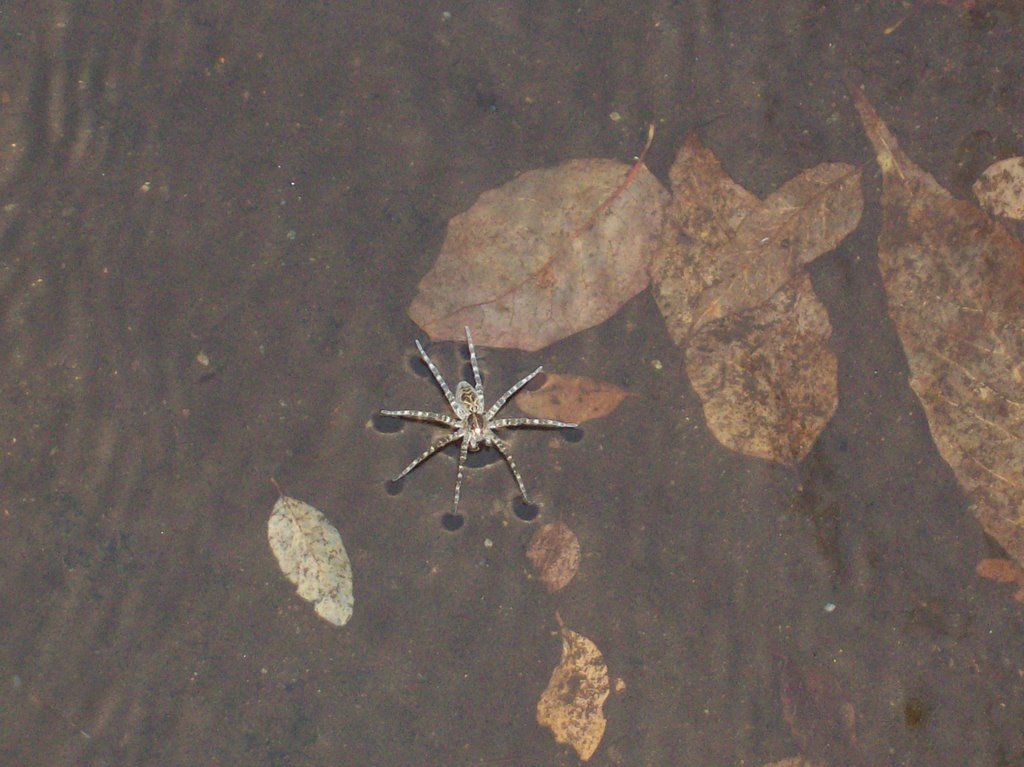
This water spider was one of my favourite finds during our trip to the Halfway River. I chose this picture to write about because when I had first found this spider it was on a little island surrounded by water. This amazed me because it looked liked a normal spider, and we all know that spiders hate water, but soon I realized that some of its legs were resting on the water while the others were holding onto the rock.

I was also surprised at how fast the spider could move on top of the water. The legs of a water spider create so much surface tension that they barely touch the water. But because the spider weighs something, its legs make an “indent” in the water where their legs contact the water. To move, the spider puts force on the indents of water under their legs. The indent creates a drag or resistance on the water, which allows the spider to push away from the water and push it behind. This allows the spider to move forwards very fast.

If you look at the picture of the spider on top of the water, then you can see the indents underneath each one of its eight legs, and you can also see that its body is resting on the water because of the “shadow” figure underneath it. (Click on picture for larger image.)

I thought a spider like this might be darker so it would be able blend in more easily with the water’s bottom. But instead it blends in with leaves and sticks which may indicate that it spends most of its time on the land and only goes to the water for food, or to escape from land predators. - a student